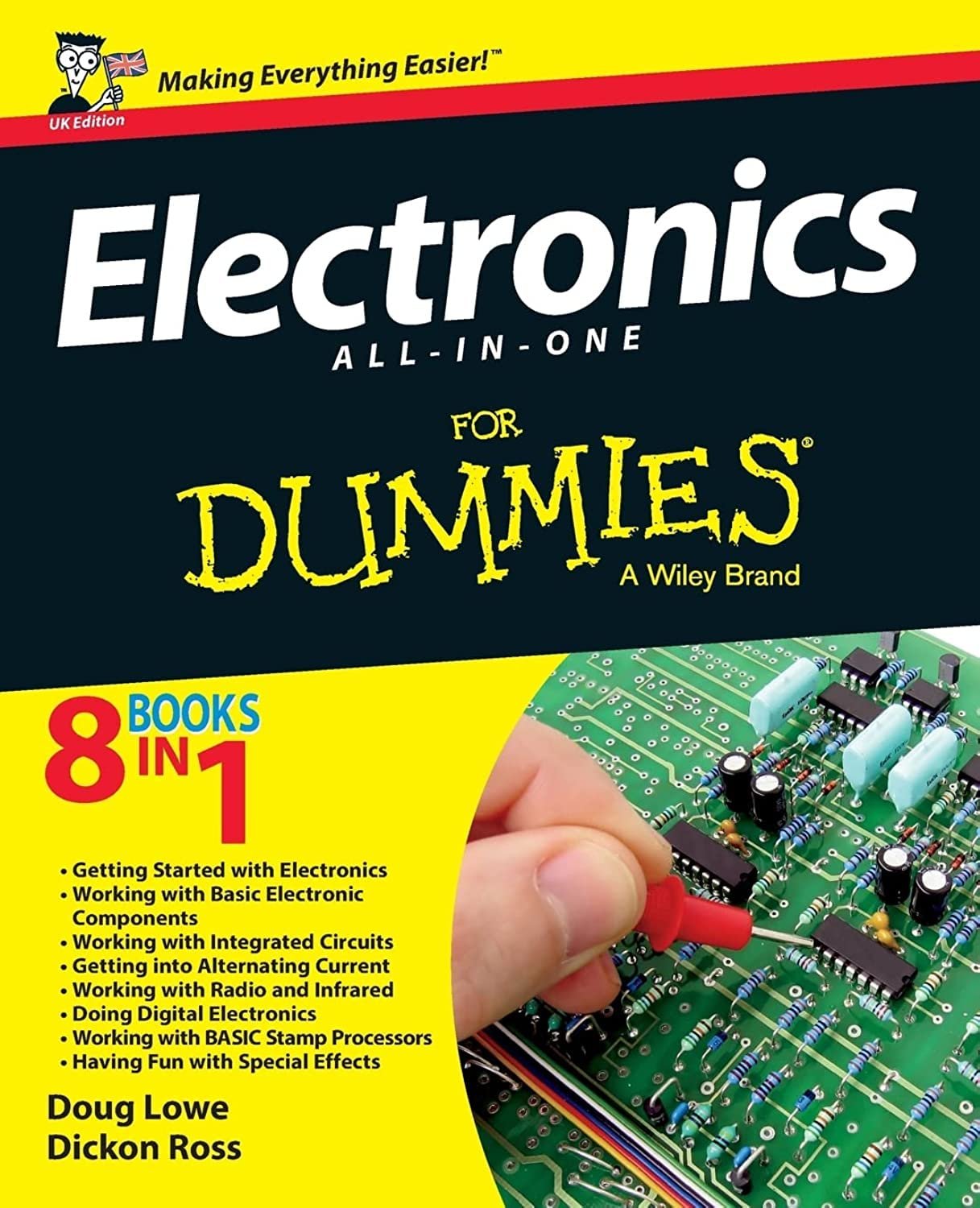



Review: Master the Circuit with Electronics All-In-One Desk Reference For Dummies (UK Edition)
Electronics is one of those fascinating fields that often feels locked behind a gate of complex mathematics and intimidating jargon. Whether you are a total beginner wanting to fix a broken radio, a student struggling with engineering concepts, or a hobbyist looking to join the “Maker” revolution, finding a single resource that covers it all is difficult.
Enter the Electronics All-In-One Desk Reference For Dummies (UK Edition). Weighing in at over 1 kilogram and boasting nearly 900 pages, this isn’t just a light read—it is a comprehensive workshop in paper form. But does quantity equal quality? In this review, we dismantle this massive volume to see if it truly is the “one-stop shop” for aspiring electronics wizards.
The “All-In-One” Advantage: 8 Books in One Volume
The standout feature of this desk reference is right in the title: “All-In-One.” Instead of forcing you to buy separate books for digital logic, analog circuits, and safety procedures, this guide combines 8 distinct mini-books into a single, cohesive volume. This format is incredibly cost-effective and convenient, acting as a linear curriculum that guides you from zero knowledge to building complex gadgets.
Here is a breakdown of what you get inside:
1. Getting Started with Electronics
This section creates the foundation. It demystifies the frightening aspects of electricity—voltage, current, and resistance—and explains them in plain English. It covers setting up your workbench, choosing the right tools (multimeters, soldering irons), and most importantly, safety.
2. Working with Basic Components
You cannot build a house without bricks, and you cannot build circuits without components. This mini-book introduces you to the “active” and “passive” players on a circuit board: resistors, capacitors, inductors, and diodes. It explains not just what they are, but why you use them.
3. Working with Integrated Circuits (ICs)
This is where modern electronics comes alive. The book guides you through the world of “chips,” including the legendary 555 timer and operational amplifiers (op-amps). Understanding ICs is the key to shrinking massive circuits into manageable projects.
4. Getting into Alternating Current
Most hobbyist projects run on Direct Current (batteries), but the real world runs on Alternating Current (AC). This section tackles the more complex physics of AC, essential for understanding power supplies and household electronics.
5. Working with Radio and Infrared
If you have ever wanted to understand how your TV remote works or how to build a simple radio receiver, this section is pure gold. It covers the invisible waves that connect our world, demystifying frequency, modulation, and wireless communication.
6. Doing Digital Electronics
We live in a digital age. This mini-book transitions you from analog waves to the binary world of 1s and 0s. You will learn about logic gates, truth tables, and how computers actually “think” at a hardware level.
7. Working with Basic Stamp Processors
Before Arduino and Raspberry Pi took over the world, the BASIC Stamp was the king of microcontrollers. While the technology has evolved, the programming logic and interfacing concepts taught here are timeless and directly transferable to modern platforms.
8. Building Special Effects
Finally, the book rewards your study with fun. This section focuses on applying what you have learned to create lights, sounds, and motion—perfect for props, toys, or just showing off your new skills.
Why the “UK Edition” Matters
You might wonder, “Does it really matter if I buy the US or UK edition?” In the world of electronics, the answer is a resounding yes.
While the laws of physics don’t change across the Atlantic, the logistics do. The UK Edition has been specifically tailored to ensure that the practical advice is actionable for a British audience.
Localized Components and Sourcing
One of the most frustrating experiences for a hobbyist is finding a schematic online that uses a part only available in North America. This edition points you toward components standard in the UK market. It lists UK suppliers and retailers, saving you from expensive international shipping fees or hours of searching for equivalent parts.
Safety Standards and Units
Electrical safety standards and mains voltage differ between the US (120V) and the UK (230V). This book respects those differences, ensuring that when you are working with higher powers or looking for power supplies, the advice is safe and relevant to UK infrastructure. It also adheres to metric measurements, avoiding the confusion of converting imperial units when measuring wire lengths or board dimensions.
The “Dummies” Methodology: Accessible and Engaging
The “For Dummies” brand has survived for decades for one reason: it respects the reader’s intelligence while removing the intimidation factor.
Breaking Down the Wall of Math
Electronics engineering is notoriously math-heavy. However, this book manages to teach the necessary formulas (like Ohm’s Law) without bogging you down in abstract calculus. The tone is conversational and witty, acting more like a knowledgeable friend guiding you at a workbench than a stern professor at a blackboard.
Visual Learning
With hundreds of schematics, diagrams, and photos, the book caters to visual learners. Complex wiring diagrams are often accompanied by clear illustrations showing how the physical connection should look. This is vital for beginners who might struggle to translate a circuit symbol into a physical connection on a breadboard.
Who Is This Book For?
The Aspiring Hobbyist and Maker
If you have recently bought a soldering iron or want to get into the “Maker” movement (3D printing, robotics, DIY repair), this is the perfect reference manual. It fills in the gaps that YouTube tutorials often skip.
Students and Apprentices
For those studying GCSE or A-Level Physics, or starting an apprenticeship in electrical engineering, this book serves as a fantastic supplementary text. It clarifies concepts that textbooks often make overly complicated.
The “Refresher” Engineer
Even if you studied electronics years ago, technology moves fast, and memory fades. This desk reference is exactly that—a reference. It is the book you keep on your shelf to quickly look up a pinout, a formula, or a component property when you are in the middle of a project.
Final Verdict
The Electronics All-In-One Desk Reference For Dummies (UK Edition) is a triumph of technical writing. It manages to pack a library’s worth of information into a single, portable (albeit heavy) volume. By combining theory with practice, and tailoring the content specifically for the UK market, it removes the barriers to entry for one of the most rewarding hobbies in the world.
Whether you want to repair a vintage radio, build a robot, or simply understand how the world around you works, this book is the tool you need to get started.
Get your copy on Amazon today and start building
View on Amazon
Related Posts

TiMOVO Case for iPad (A16) 11th Generation 11 Inch 2025/iPad 10th Generation 10.9 Inch 2022, Slim Stand Cover with Hard Translucent Back, Support Touch ID, Auto Wake/Sleep, Abyss Blue
From the brand Protection Meets Personal Style: The TiMOVO Case…

Amazon Kindle (16 GB) – Lightest and most compact Kindle
Amazon Product Review: The Lightest & Most Compact Kindle…

Apple iPad 11-inch: A16 chip, 11-inch Model, Liquid Retina Display, 128GB, Wi-Fi 6, 12MP Front / 12MP Back Camera, Touch ID, All-Day Battery Life — Silver
Amazon Product Review: Apple iPad (11-inch) Feature Details…